Aged Infrastructure Causes Major Air Traffic Collapse
A contractor's upgrade to convert copper wires to fiber optic lines triggered a four-hour nationwide ground stop, leaving thousands of travelers stranded across the country.
By Silas Grundvig ·
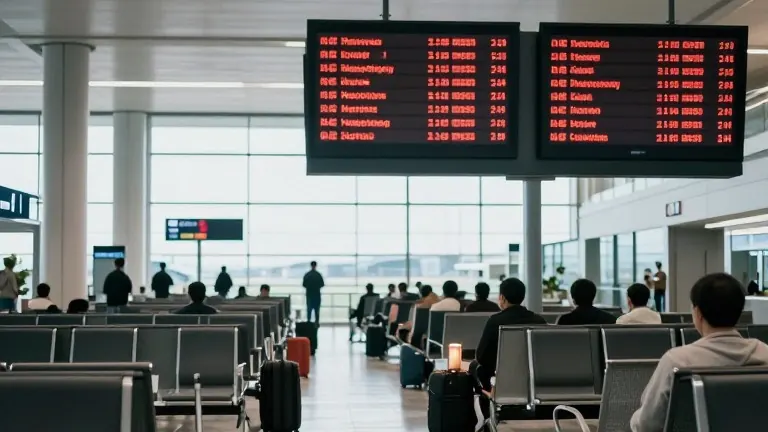
A nationwide air traffic ground stop that lasted four hours on Friday stemmed from an error during routine maintenance on aging federal infrastructure, Transportation Secretary Sean Duffy announced on Saturday. The incident halted thousands of flights, representing the second time since the September 11, 2001 attacks that the U.S. aviation system was fully shut down. Duffy stated that the problem originated when a contractor attempted to replace copper wire with fiber optic lines at a Federal Aviation Administration remote location.
Duffy identified L3Harris, a long-standing FAA contractor, as the firm performing the work. He noted that the routers installed in those facilities were manufactured in 2001. The secretary explained that such transitions from analog to digital systems have occurred across American institutions for decades, though he acknowledged that the FAA has lagged behind due to delayed investments. Duffy described the task as uncomplicated, comparing it to standard upgrades seen in other sectors.
The FAA is currently investigating the specific mechanical or procedural failure that caused other routers in the air traffic control system to flood with data. Investigators are determining whether the root cause was user or installer error by the contractor, or if a defective router was installed. L3Harris has not yet responded to requests for comment regarding the incident.
FAA Administrator Bryan Bedford stated that there is no evidence the outage was caused by malicious activity or artificial intelligence. Although the FAA is rolling out an AI-enhanced software tool called SMART as part of a larger system overhaul, the developer, Air Space Intelligence, said the company’s tools were not the source of the disruption. The company issued a statement clarifying that the ground stop was not a result of its integration with the FAA.
The system was restored to operation on Saturday morning, but delays and cancellations continued. Duffy projected that the chaos would persist for several days, though he expressed confidence that the network would be fully functional before the Thanksgiving travel peak. Bedford reported that airlines aim to restore full schedule integrity by the end of the business day on Sunday.
Data from the tracking site FlightAware indicated that nearly 25,000 flights were delayed and over 9,000 were cancelled on Friday. Cirium, an aviation analytics firm, reported that more than 4,000 additional cancellations occurred on Saturday morning, accounting for 14% of all U.S. departures. Homeland Security Secretary Markwayne Mullin, who joined Duffy at a White House briefing, confirmed that investigators found no signs of a cyberattack.
Passengers faced significant inconvenience at major hubs. At Tampa International Airport, travelers waited in terminals for extended periods, while flight boards at Ronald Reagan Washington National Airport showed numerous delays extending into the early morning. One couple from Ocean City, New Jersey, abandoned their flight and drove four hours to the airport to pick up their partner. Others switched to Amtrak, which experienced a brief system outage on Friday night.
More News · National news · Report a business · Got a Story?